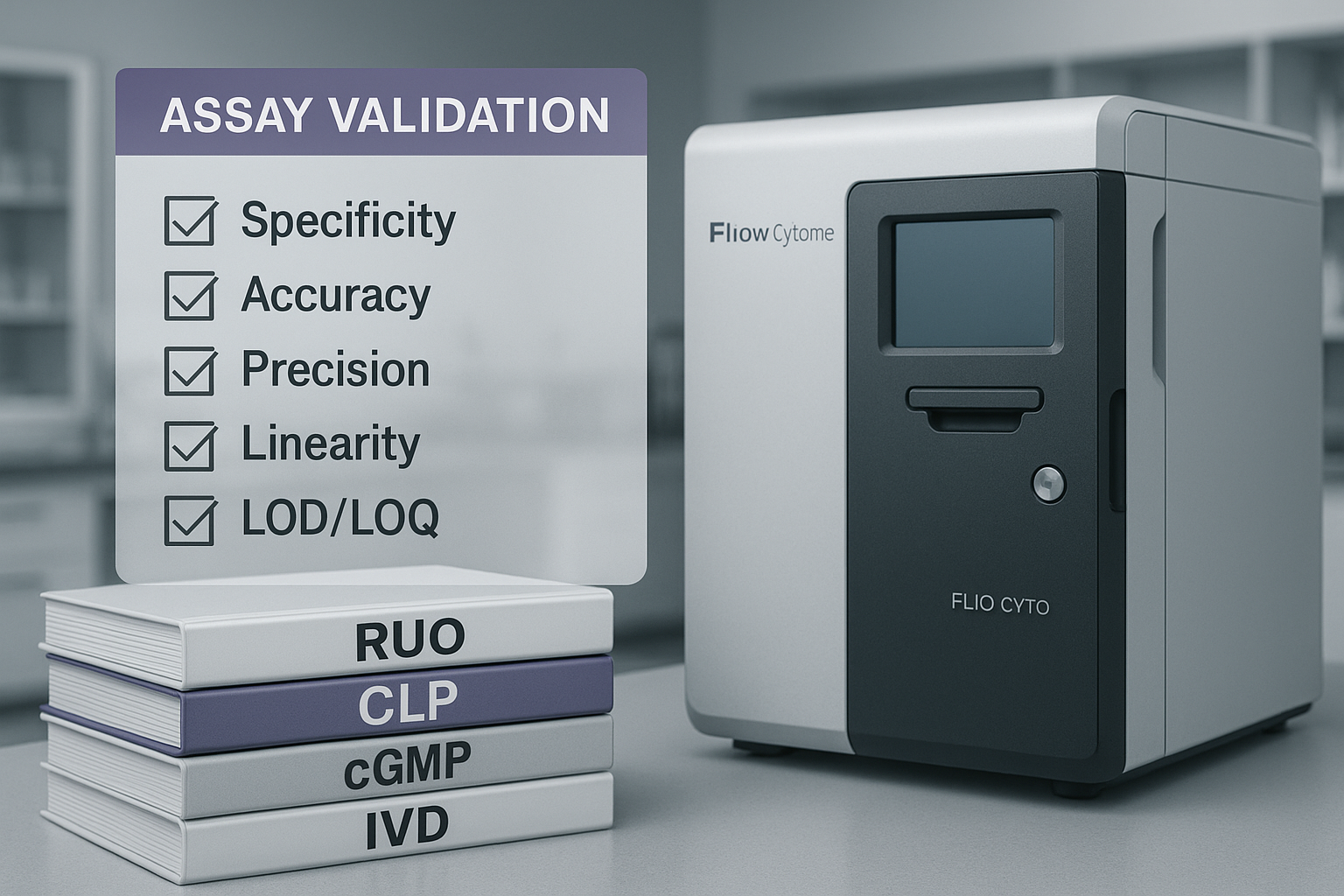
Course 9: Assay and Panel Validation for RUO cGMP GLP
– Understand the regulatory rationale for validating flow cytometry assays in RUO, GLP, CLIA, cGMP, and
IVD settings.
– Identify and apply validation parameters including specificity, accuracy, precision, linearity, and
LOD/LOQ.
– Differentiate validation requirements across regulatory contexts (e.g., FDA vs. CLIA).
– Describe and implement best practices for validation documentation and audit preparedness.
– Evaluate robustness, stability, and carryover parameters in a flow assay validation plan.
– Understand how to validate and troubleshoot assays for cell identity, viability, and functional potency
(e.g., CAR-T assays).
– Implement appropriate gating strategies and analysis software for consistent and reproducible data.
– Compare methods such as spike-in recovery vs. reference method, and FMO vs. isotype controls.
– Gain familiarity with spectral vs. conventional flow validation approaches and key publications (e.g.,
CLSI H62, MIFlowCyt).
– Successfully passed the post-training quiz to demonstrate comprehension of course material.