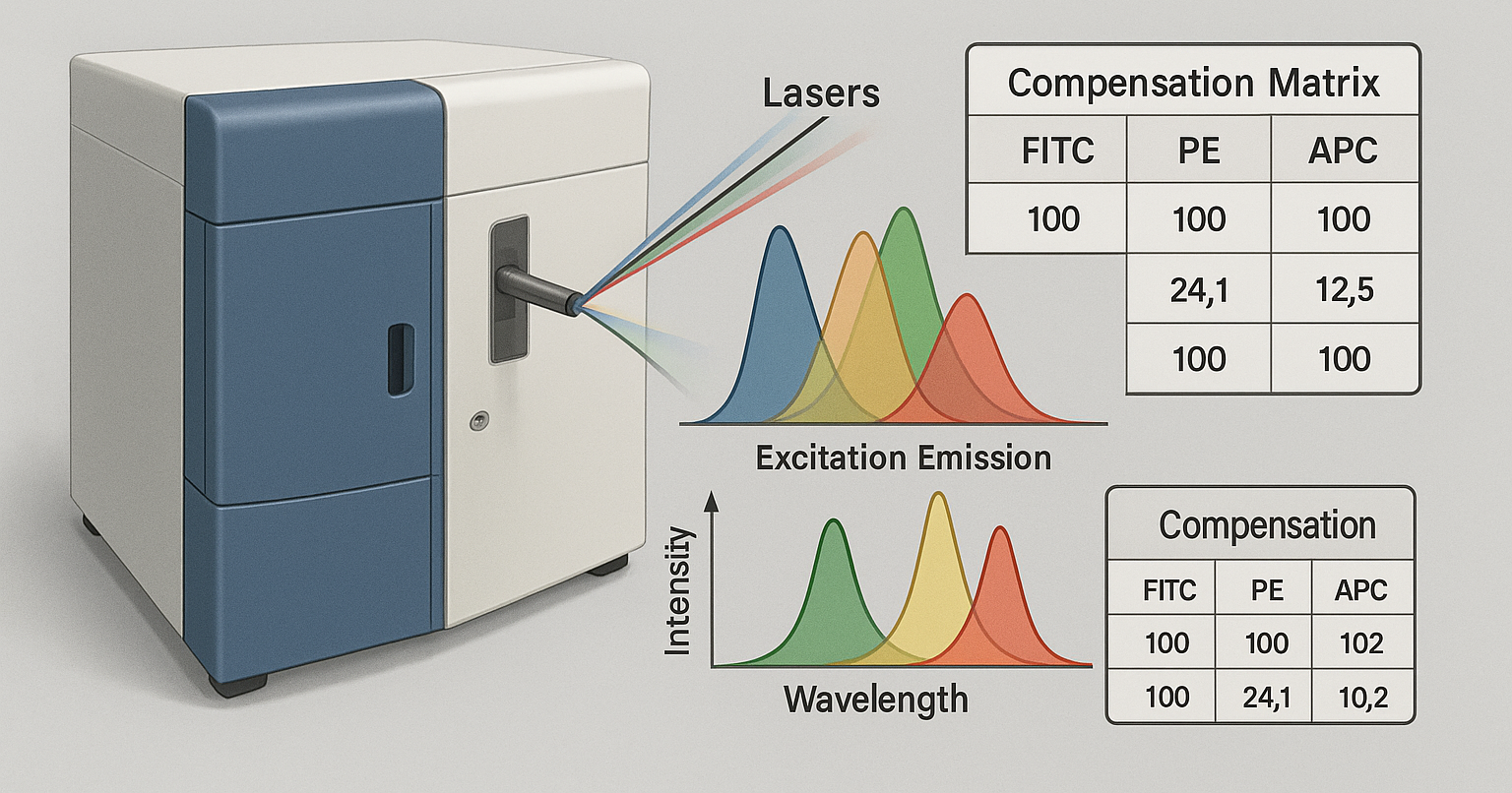
– The core principles of flow cytometry and the role of fluorochromes in high-parameter single-cell
analysis.
– The physics behind excitation and emission spectra and their significance in fluorochrome selection.
– How fluorochrome brightness and Stain Index (SI) impact signal clarity and panel design.
– The consequences of spectral overlap and spillover and their effect on data interpretation.
– The characteristics and applications of commonly used fluorochromes (FITC, PE, APC, BV dyes, PerCP) in
flow cytometry.
– The concept of compensation and its necessity in correcting spectral spillover for accurate data analysis.
– The mathematical principles behind compensation, including spillover coefficients and compensation
matrices.
– How to properly set up and validate compensation controls to ensure data integrity.
– The differences between conventional and spectral flow cytometry systems and their respective
advantages.
– The impact of photobleaching, fixation sensitivity, and spillover spreading on the quality of flow
cytometry results.
– The use of automated compensation versus manual compensation and the benefits of software-driven
solutions.
– Emerging trends in flow cytometry, including spectral unmixing algorithms, AI-assisted gating, and
lifetime cytometry.